
Understanding Glycemic Index vs. Glycemic Load: What People with Diabetes Need to Know
Managing diabetes often involves making thoughtful food choices, especially when it comes to carbohydrates. You may have heard terms like glycemic index (GI) and glycemic load (GL), but understanding what they mean—and how they differ—can be confusing.
While both measurements relate to how carbohydrate-containing foods affect blood glucose, they are not the same. Understanding the difference can help you make more informed dietary choices without unnecessarily restricting your favorite foods.
This guide explains what glycemic index and glycemic load are, how they're calculated, their limitations, and how to use them as practical tools for diabetes management.
Why Carbohydrates Affect Blood Sugar
Carbohydrates are your body's primary source of energy. During digestion, carbohydrates break down into glucose, which enters the bloodstream.
As blood glucose rises, the pancreas releases insulin to help move glucose into the body's cells for energy. In people with diabetes, this process doesn't work as efficiently, making blood glucose management more challenging.
However, not all carbohydrate-containing foods affect blood sugar in the same way. Some foods raise blood glucose quickly, while others produce a slower, more gradual increase.
This is where glycemic index and glycemic load become useful.
What Is the Glycemic Index?
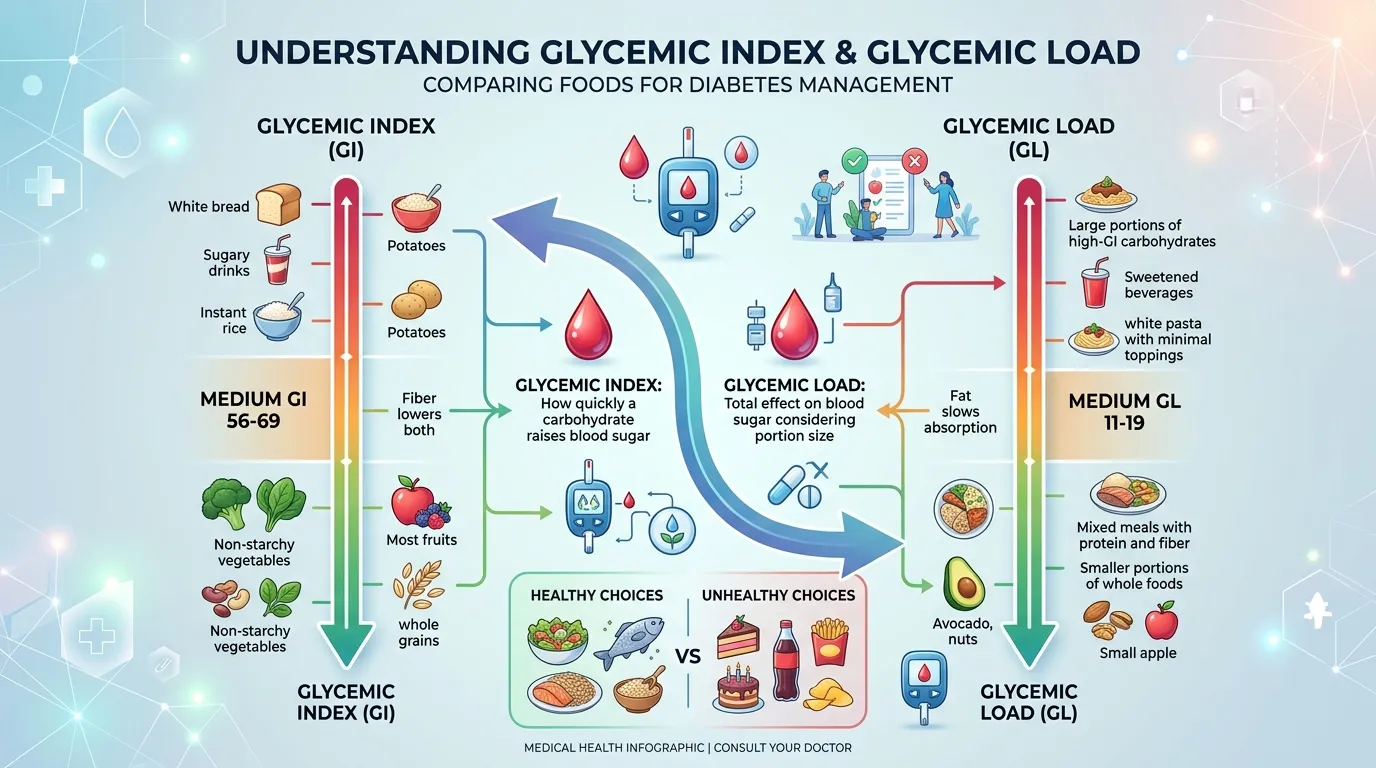
The glycemic index (GI) measures how quickly a carbohydrate-containing food raises blood glucose compared with a reference food, usually pure glucose.
Foods receive a score from 0 to 100.
Generally, foods are classified as:
- Low GI: 55 or less
- Medium GI: 56–69
- High GI: 70 or higher
Foods with a lower GI tend to digest and absorb more slowly, leading to a more gradual rise in blood sugar.
Higher GI foods digest more rapidly, often causing blood glucose to increase more quickly.
Examples of Low-, Medium-, and High-GI Foods
Low GI Foods
Examples include:
- Lentils
- Chickpeas
- Most beans
- Steel-cut oats
- Plain Greek yogurt
- Apples
- Pears
- Oranges
- Most non-starchy vegetables
- Medium GI Foods
- Examples include:
- Brown rice
- Sweet corn
- Whole wheat products (varies)
- Pineapple
- High GI Foods
- Examples include:
- White bread
- Instant mashed potatoes
- White rice (some varieties)
- Rice cakes
- Sugary breakfast cereals
- Pretzels
Keep in mind that GI values can vary depending on how foods are prepared and processed.
What Is Glycemic Load?
While glycemic index measures how quickly a food raises blood sugar, it doesn't consider how much carbohydrate is actually eaten.
This is where glycemic load (GL) provides additional information.
Glycemic load combines:
- The food's glycemic index
- The amount of digestible carbohydrate in a typical serving
As a result, glycemic load often gives a more realistic picture of how a serving of food may affect blood glucose.
General glycemic load categories are:
- Low GL: 10 or less
- Medium GL: 11–19
- High GL: 20 or more
- Why Glycemic Load Is Often More Practical
- Imagine eating two different foods with the same glycemic index.
One contains only a small amount of carbohydrate per serving, while the other contains much more.
Although both foods have similar GI scores, their effects on blood sugar may differ significantly because of the total carbohydrate consumed.
For example, watermelon has a relatively high glycemic index but contains relatively little digestible carbohydrate in a standard serving. As a result, its glycemic load is much lower than many people expect.
This demonstrates why looking only at glycemic index can sometimes be misleading.
Factors That Influence a Food's Glycemic Response
Several factors can change how quickly carbohydrates are digested and absorbed.
Fiber
Foods rich in dietary fiber generally digest more slowly, helping reduce rapid spikes in blood glucose.
Examples include:
- Beans
- Lentils
- Vegetables
- Whole grains
- Chia seeds
- Protein
- Adding protein to a meal slows digestion and may help improve satiety.
- Examples include:
- Chicken
- Fish
- Eggs
- Tofu
- Greek yogurt
- Healthy Fats
Healthy fats also slow stomach emptying, which may reduce the speed at which glucose enters the bloodstream.
Sources include:
- Avocados
- Nuts
- Seeds
- Olive oil
- Food Preparation
- Cooking methods can change a food's GI.
- For example:
- Al dente pasta generally has a lower GI than overcooked pasta.
- Less processed oats have a lower GI than instant oatmeal.
- Whole fruit usually has a lower GI than fruit juice.
- Processing Matters
Highly processed foods are often digested more quickly than minimally processed foods.
For example:
- Whole oats generally produce a slower blood sugar response than instant oats.
- Whole fruit usually raises blood glucose more gradually than fruit juice.
- Intact whole grains often have a lower GI than refined grain products.
Choosing less processed foods whenever possible can support more stable blood glucose levels while providing additional fiber and nutrients.
Use Glycemic Index and Glycemic Load Together
Rather than focusing exclusively on one measurement, many registered dietitians and diabetes educators recommend considering both glycemic index (GI) and glycemic load (GL) alongside overall nutrition.
For example, when comparing two foods, you might ask:
Which option contains more fiber?
Which has a lower glycemic load?
Does it provide vitamins and minerals?
How much added sugar does it contain?
What portion size am I planning to eat?
Using GI and GL as guides—not strict rules—can help you make balanced, sustainable food choices.
Build Meals That Support Steady Blood Sugar
A meal's overall effect on blood glucose depends on more than one ingredient. Combining carbohydrates with protein, healthy fats, and fiber can help slow digestion and reduce rapid glucose spikes.
For example:
- Breakfast
- Instead of:
- Sugary cereal with fruit juice
- Try:
- Plain oatmeal topped with berries and chopped walnuts, served with a boiled egg
- Lunch
- Instead of:
- White bread sandwich with chips
- Try:
Whole-grain bread with grilled chicken, lettuce, tomato, avocado, and a side salad
Dinner
Instead of:
- Large serving of white rice with fried meat
- Try:
Grilled salmon, roasted vegetables, and a moderate serving of brown rice or quinoa
Snacks
Choose combinations such as:
- Apple slices with peanut butter
- Greek yogurt with berries
- Carrot sticks and hummus
- A handful of almonds with a small piece of fruit
Balanced meals often have a more predictable effect on blood glucose than meals centered around refined carbohydrates alone.
Common Misconceptions About Glycemic Index
There are several myths surrounding glycemic index that can lead to unnecessary food restrictions.
Myth: High-GI Foods Are Always Unhealthy
Not necessarily.
Some nutritious foods have moderate or high GI values but still provide important vitamins, minerals, and antioxidants. For example, watermelon and certain tropical fruits may have higher GI scores but are still part of a healthy eating pattern when eaten in appropriate portions.
Myth: Low-GI Foods Can Be Eaten Without Limits
Also false.
Even foods with a low GI can contribute significant calories and carbohydrates if eaten in very large amounts. Portion size remains one of the most important factors in diabetes management.
Myth: GI Alone Determines Blood Sugar Control
Blood glucose is influenced by many factors, including:
- Portion size
- Total carbohydrate intake
- Physical activity
- Medications
- Stress
- Sleep quality
- Illness
- Individual insulin sensitivity
- GI is only one piece of the puzzle.
- Limitations of Glycemic Index
- While GI is a useful educational tool, it has several limitations.
- It Measures Foods Individually
GI values are determined using single foods eaten in isolation. In real life, most meals contain a combination of carbohydrates, protein, fat, and fiber, which changes the body's glucose response.
Serving Size Isn't Considered
A food with a high GI may have a low glycemic load if a typical serving contains relatively little carbohydrate.
Preparation Changes GI
Cooking methods, ripeness, food processing, and even storage can affect a food's glycemic index.
For example:
- A ripe banana generally has a higher GI than a less-ripe banana.
Mashed potatoes typically raise blood glucose more quickly than boiled potatoes.
Overcooked pasta usually has a higher GI than pasta cooked al dente.
Individual Responses Vary
No two people respond to food exactly the same way.
Age, body composition, medications, digestive health, activity level, and diabetes type can all influence how blood glucose responds after eating.
Monitoring your own blood glucose can provide valuable insight into how specific foods affect you personally.
Practical Tips for Using GI and GL
You don't need to memorize glycemic index tables to benefit from these concepts.
Instead, consider these simple habits:
- Choose whole grains more often than refined grains.
- Include vegetables at every meal.
- Pair carbohydrates with lean protein.
- Add healthy fats in moderation.
- Eat appropriate portion sizes.
- Limit sugar-sweetened beverages.
- Choose whole fruit instead of fruit juice whenever possible.
- Read Nutrition Facts labels to compare products.
- Keep a food and blood glucose log to identify patterns.
These strategies can support healthier eating regardless of a food's exact GI score.
Should People with Diabetes Base Their Entire Diet on GI?
No.
Most diabetes organizations recommend focusing on an overall healthy eating pattern rather than relying solely on glycemic index.
Healthy eating includes:
- Plenty of vegetables
- Fruits in appropriate portions
- Whole grains
- Lean proteins
- Healthy fats
- High-fiber foods
- Limited added sugars
- Appropriate portion sizes
GI and GL are best viewed as additional tools that complement—not replace—these broader nutrition principles.
Frequently Asked Questions
Is glycemic load more useful than glycemic index?
For many people, yes. Glycemic load considers both the quality and quantity of carbohydrates in a serving, making it a more practical measure of how a typical portion may affect blood glucose.
Are all low-GI foods healthy?
No. Some foods may have a low GI but still be high in saturated fat, sodium, or calories. Always consider the overall nutritional value of a food.
Should I avoid high-GI foods completely?
Not necessarily. Many higher-GI foods can fit into a healthy meal plan when eaten in appropriate portions and combined with protein, healthy fats, or fiber.
Does cooking affect glycemic index?
Yes. Cooking time, processing, and ripeness can all change how quickly carbohydrates are digested and absorbed.
Can GI and GL help with weight management?
They may be helpful for some people, especially when they encourage choosing higher-fiber, minimally processed foods. However, overall calorie intake, physical activity, and long-term eating habits remain key factors in weight management.
Key Takeaways
Glycemic index (GI) measures how quickly a carbohydrate-containing food raises blood glucose.
Glycemic load (GL) considers both the GI and the amount of carbohydrate in a typical serving.
GL often provides a more realistic estimate of a food's impact on blood sugar than GI alone.
Fiber, protein, healthy fats, food processing, and cooking methods all influence a meal's glycemic response.
Portion size remains important, regardless of whether a food has a low or high GI.
Rather than focusing on individual numbers, aim for balanced meals rich in vegetables, lean protein, whole grains, and healthy fats.
Use GI and GL as practical tools to support informed food choices—not as strict rules that eliminate entire food groups.